 How-to
How to Bundle Home and Auto Insurance: 2026 Guide
Table of Contents
- What Bundling Home and Auto Insurance Actually Means
- Step-by-Step: How to Bundle Home and Auto Insurance
- How to Compare Home and Auto Insurance Quotes
- Understanding the Home and Auto Insurance Bundle Discount
- Bundling Homeowners and Auto Insurance Pros and Cons
- Switching Home and Auto Insurance Without a Coverage Gap
- Common Mistakes to Avoid When Bundling
- Frequently Asked Questions
Last Updated: October 11, 2026
What Bundling Home and Auto Insurance Actually Means
To bundle home and auto insurance means buying your homeowners policy and car insurance from the same provider, usually for a multi-policy discount on both premiums. At Countryside Insurance Agency, we explain it this way: you are not buying one product, but two policies that share a billing account, a renewal date, and often a claims contact.
That distinction matters: a bundle does not merge your coverage. Your home policy keeps its own limits, deductible, and property terms; your auto policy keeps its own liability, collision, and comprehensive coverage.
The National Association of Insurance Commissioners consumer resources publishes guidance on how policies and discounts are regulated state by state, which is a useful starting point before you assume any bundle works the same way everywhere.
Step-by-Step: How to Bundle Home and Auto Insurance
Bundling takes an afternoon of preparation and two to three weeks of quote gathering. Follow this sequence in order, because doing it out of order is how people compare the wrong numbers.
Step 1: Assess Your Current Coverage and Needs
Start by listing what you own and need to protect. Pull your declarations pages and note the coverage limits, deductibles, and endorsements on each policy.
Then check the basics: is your home value current, has your vehicle value changed, and do you have personal property needing scheduled coverage? If your life has changed since your last review, your coverage needs probably have too.
- Home value and estimated replacement cost
- Vehicle value and annual mileage
- Current coverage limits on both policies
Step 2: Gather Your Policy Documents and Vehicle Information
You cannot get an accurate quote without accurate inputs. Have your declarations pages, vehicle identification numbers, and property details ready before requesting quotes.
Small input differences create large quote differences. A wrong roof age or misstated mileage can swing a quote enough to make the wrong insurer look cheapest. Get the facts right once, then reuse them across every quote.
Step 3: Request Quotes from Multiple Insurers
Request bundled and separate-policy quotes from the same insurers. Most people skip this step, yet it determines whether bundling actually saves you money.
Ask each provider for four numbers:
- Bundled annual premium for both policies
- Home policy premium quoted alone
- Auto policy premium quoted alone
- The stated discount percentage and how it is applied
How to Compare Home and Auto Insurance Quotes
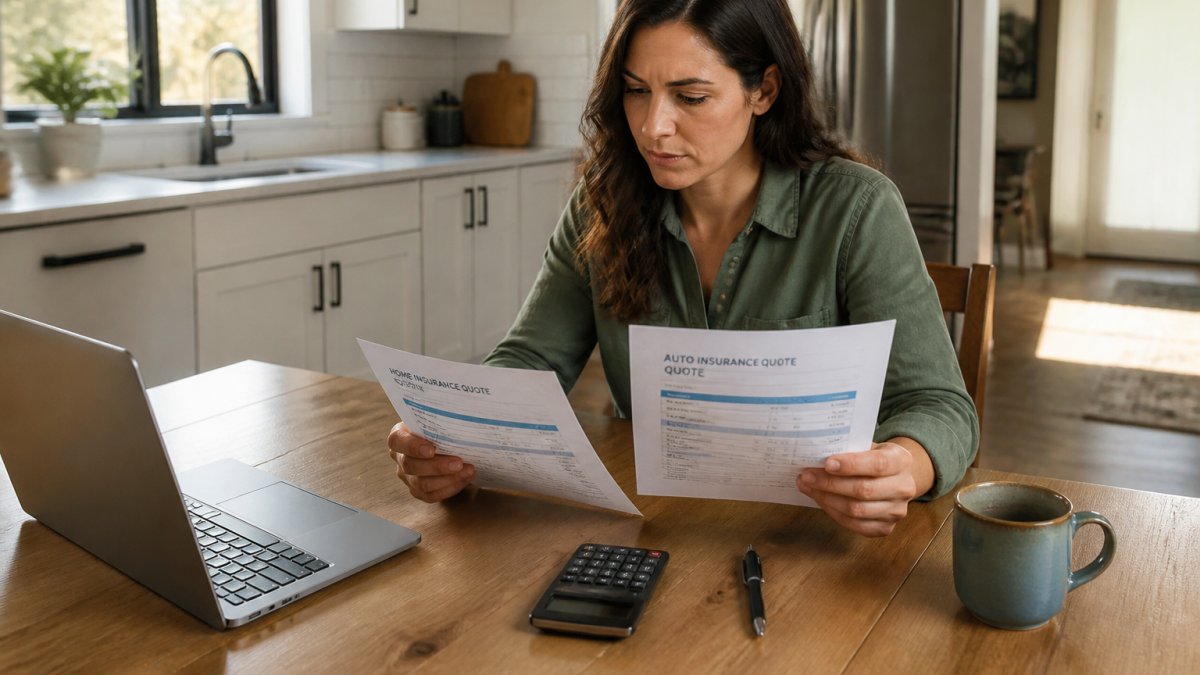
Comparing quotes means comparing total cost for equivalent coverage, not headline premiums. Two quotes are comparable only when limits, deductibles, and endorsements match.
Here is the worksheet we use with clients. Build it in a spreadsheet, one row per insurer.
| What to Compare | Why It Matters | Red Flag |
|---|---|---|
| Annual premium, bundled | Your real yearly outlay | Only a monthly payment shown |
| Annual premium, separate | Baseline for the discount | Provider won't quote separately |
| Coverage limits | Determines what's paid out | Limits lower than your current policy |
| Deductible | Your out-of-pocket at claim time | Deductible quietly raised to cut premium |
| Discount percentage | The actual bundle benefit | Discount applied to one policy only |
| Replacement cost basis | How property claims settle | Actual cash value substituted |
| Claims contact | Who handles your claim | Different process for each policy |
| Renewal terms | Whether the discount persists | Discount described as introductory |
Understanding the Home and Auto Insurance Bundle Discount
A home and auto insurance bundle discount is a percentage reduction applied to one or both premiums when you hold multiple policies with the same insurer.
Three things determine what you actually get:
- Eligibility rules. Some insurers require both policies to be active on the same effective date. Others allow a grace period.
- Underwriting. A bundle does not guarantee acceptance. Each policy is still underwritten on its own merits, so a home in a high-risk area can still be declined even if your auto record is clean.
- Discount terms. Some discounts are permanent, others are introductory and step down at renewal. Read the terms, not the brochure.
This is where bundling gets oversold: a discount on a repriced base premium can leave you paying more than separate policies, which is why the comparison worksheet matters more than any advertised savings figure.
Bundling Homeowners and Auto Insurance Pros and Cons
Bundling homeowners and auto insurance is worth it for some households and a waste of money for others, depending on your risk profile, property, and how each insurer prices you. What most guides skip is the mechanism: the discount applies to a base premium the insurer sets independently, so a large discount on a high base rate can still cost more than two separate policies with lower base rates.
Pros
- One renewal date and billing account, reducing the chance of a missed payment
- A multi-policy discount that can apply to both premiums, though the percentage and which policy it attaches to vary by insurer
- A single claims contact when one event touches both policies, such as a storm damaging your home and car
Cons
- The bundle discount can mask a higher base premium. If the insurer's standalone home rate is above market, a 15% discount may still leave your combined cost higher than two separate policies from two insurers.
- You lose the ability to pick the best insurer for each risk. The insurer with the best auto rates may not have the best home rates for your roof age and location.
- A claim on one policy can affect the other at renewal. Some insurers review the entire account and may surcharge or non-renew both after a single large loss.
When a Bundle Costs More Than Separate Policies
A bundle can cost more than separate policies when:
- The insurer's base rates are above market. A 20% discount on a home premium that is 30% above the competitive rate still leaves you overpaying.
- The discount applies to only one policy. If the multi-policy discount reduces only the auto premium, the home premium may be higher than a standalone policy elsewhere.
- The discount is introductory. Some insurers apply a first-term discount that steps down at renewal, so the second year costs more than the first.
- Coverage is not equivalent. A cheaper bundle with lower dwelling coverage, actual cash value instead of replacement cost, or a higher deductible is not a saving, it is a downgrade.
- You have a claim. A single at-fault auto accident or a home water damage claim can trigger a surcharge on both policies at renewal, erasing the discount.
To identify this, compare the bundled annual premium against the two best standalone quotes for equivalent coverage. If the bundled total is higher, the discount is not working in your favor.
Bundling is a pricing decision, not a coverage decision. It changes what you pay and how you manage the policies. It does not change what each policy covers. Run the numbers on equivalent coverage before you assume the bundle wins.
Switching Home and Auto Insurance Without a Coverage Gap
A coverage gap happens when one policy ends before the replacement starts. On a home policy it is dangerous, because a loss during an uninsured day is covered by no one. On an auto policy, a gap can trigger a lapse penalty and higher rates when you reinstate.
The safe sequence is simple, but the details matter:
- Get the new policies bound with an effective date on or before your current policies' expiration. Do not cancel first and shop later.
- Confirm in writing that the new coverage is active. Get the declarations page and policy number for both policies before cancelling anything.
- Cancel the old policies only after the new ones are confirmed. Most insurers let you cancel effective the same day the new policy starts, so there is no gap.
- Keep proof of continuous coverage. A declarations page or letter of experience can prevent a lapse surcharge if you switch again later.
Coordinating Effective Dates
Home and auto policies often renew on different dates. If your home renews in March and your auto in September, you have two options:
- Switch both at the next renewal of either policy. This is the cleanest approach. Bind the new home and auto policies to start on the same date, then cancel the old ones.
- Switch one policy now and the other at its renewal. This can work, but check whether the new insurer's bundle discount requires both policies to be active on the same date. Some insurers allow a grace period; others do not.
Lender and Escrow Requirements
If you have a mortgage, your lender likely requires homeowners insurance and may escrow the premium (What is homeowner's insurance? Why is homeowner's insurance required?). When you switch insurers:
- Tell your lender or servicer about the change. They need the new policy number, effective date, and premium to update escrow.
- Confirm the escrow payment adjusts correctly. A lower premium should decrease your monthly escrow payment; a higher one should increase it. A mismatch can cause a shortage or surplus at the next annual review.
- Do not cancel the old policy until the new one is confirmed with the lender. Some lenders require proof of coverage before releasing escrow funds.
Open Claims and Switching
If you have an open claim on either policy, wait until it closes before switching. Moving mid-claim complicates the process: the old insurer still handles the claim, but the new insurer may need to know about it for underwriting, and a pending claim can affect your eligibility or rate.
Cancellation Timing and Short-Rate Penalties
Most insurers let you cancel anytime, but some charge a short-rate penalty if you cancel before the term ends, meaning you get back less than the pro-rata unused premium. Ask your insurer about short-rate penalties before setting a cancellation date; if they apply, time your switch to the renewal date.
Request a written confirmation of cancellation from your old insurer, including the effective date and any refund amount. Keep it with your new policy documents in case of a dispute.
Never cancel your old policy before the new one is bound and confirmed. A single uninsured day on a home policy can leave you responsible for a total loss.
Common Mistakes to Avoid When Bundling
The biggest mistake is comparing a bundled quote against your current total without checking whether coverage is equivalent. A cheaper bundle with lower limits is not a saving, it is a downgrade.
Other mistakes we see regularly:
- Ignoring the standalone quote. Without it, you cannot measure the discount.
- Assuming the discount is permanent. Check the renewal terms before you commit.
- Forgetting the deductible. Raising a deductible to hit a target premium shifts risk back onto you.
At Countryside Insurance Agency, we are an independent firm, not tied to one insurer's bundle structure.
Bundling home and auto is not automatically cheaper, and the only way to know is to compare equivalent coverage side by side.
Frequently Asked Questions
Is it better to bundle your home and auto insurance?
Bundling can be better if the combined premium and coverage meet your needs at a lower total cost than separate policies. The multi-policy discount often reduces your annual premium, but it is not guaranteed. Compare the total cost of a bundle against separate policies from different insurance providers, and check that coverage limits, deductibles, and endorsements are equivalent. For some risk profiles, separate policies may be cheaper or offer better terms.
Does bundling home and auto insurance always save money?
No. While many insurers advertise a home and auto insurance bundle discount, the actual savings depend on your risk profile, location, home value, vehicle value, and claims history. In some cases, a lower base rate from a separate insurer for one policy can outweigh the bundle discount. Always compare the total cost of the bundle against separate policies with equivalent coverage before deciding.
How can I compare home and auto insurance bundles?
Request quotes from at least three insurers. For each quote, confirm the dwelling coverage, personal property limits, liability coverage, deductible, and any endorsements. Then compare the total annual premium for the bundle against the sum of separate policies. Use a worksheet to track premium, coverage limits, and discounts side by side. Ask each insurer for a written quote breakdown so you can verify the discount percentage applied.
When should I start a new policy to avoid a coverage gap?
Schedule the new policy's effective date to start on the same day your old policy ends. Do not cancel your existing coverage until the new policy is confirmed in writing. If you are switching home and auto insurance, align both policies to the same effective date. This prevents a lapse in coverage, which can lead to higher rates or denied claims. Confirm the new policy is active before canceling the old one.